IEEE Communications Surveys & Tutorials · 2026

A Survey of Wireless Sensing Security
From a Role-Based View

When wireless signals can be Victims, Weapons, and Shields — a single, unified map of an entire security field.

Ruixu Geng*, Jianyang Wang*, Yuqin Yuan, Fengquan Zhan, Tianyu Zhang, Rui Zhang, Pengcheng Huang, Dongheng Zhang, Jinbo Chen, Yang Hu, Yan Chen

School of Cyber Science and Technology, University of Science and Technology of China (USTC)

* Equal contribution  ·  Corresponding author

Abstract

Wireless sensing — using WiFi, mmWave radar, acoustic, RFID and other signals to perceive the physical world — has become ubiquitous, yet its security has remained fragmented and under-explored. This survey presents the first comprehensive review of wireless sensing security from 2004 to early 2025.

We extend the classical sensing model into a unified security perspective, which naturally yields the paper's central contribution: a role-based classification that organizes research by the role wireless signals play — Victims of attacks, Weapons for attacks, or Shields for security applications. Through a systematic analysis of over 430 publications collected in the open Awesome-WS-Security database, we map the landscape, surface the field's defining challenges, and chart promising directions: multi-physics modeling, AI-driven intelligent security, and proactive defense.

01

The first systematic review of wireless sensing security, covering vulnerabilities and protections together.

02

A role-based framework grounded in a unified signal model — intuitive, comprehensive, with clear boundaries.

03

An open, living database of 430+ labeled papers with reproducible statistical analysis.

04

A synthesis of challenges & future directions spanning attack evolution and defense innovation.
The Foundation

One equation to read the whole field

Every wireless sensing system — and every attack or defense against it — can be expressed through a single unified model. Security is then simply a question of which component of the signal chain is being exploited or protected.

The received baseband signal y(t) is the sum of channel transformations of the transmitted signal, plus noise. Sensing means estimating the parameters Θi. Tap a component below.

The Role-Based Framework

Three roles a wireless signal can play

Device-based or threat-based taxonomies fracture the field. The role of the signal — target, vector, or tool — is intuitive, captures fundamental relationships, and gives every work a clear home.

Category I

Victims

Wireless sensing systems are the attack targets. Adversaries disrupt parameter estimation by manipulating the source, channel, or target — and defenders harden system resilience.

Corrupt the estimation of Θi from y(t)
  • Attacks on targets — static / dynamic modulation, adversarial examples
  • Attacks on sources — jamming, spoofing, adversarial signals
  • Attacks on channels — communication & sensing-channel manipulation
  • Defenses — robustness, detection, physical-layer protection

e.g. spoofing mmWave radar in autonomous driving · adversarial attacks on RF sensing

Category II

Weapons

Wireless signals become the attack tool against other systems — eavesdropping, side channels, and interference that steal information or cause malfunction.

Maliciously estimate sensitive Θi from y(t)
  • Active attacks — vibration eavesdropping, EMI injection, channel manipulation
  • Passive attacks — device-leakage & protocol-signal eavesdropping
  • Defenses — physical-layer & application-layer countermeasures

e.g. mmWave acoustic eavesdropping · EM & magnetic side channels · WiFi keystroke inference

Category III

Shields

Wireless signals serve as guardians — exploiting the uniqueness or controllability of the signal chain to deliver security and privacy.

Exploit uniqueness / control of Θi, hi, n(t)
  • Human identification & authentication — gait, voice, face, vital signs
  • Device authenticity — RF fingerprinting, media authenticity
  • Privacy protection — threat detection & data protection

e.g. mmWave identity authentication · RF-based gait recognition · hidden-camera detection

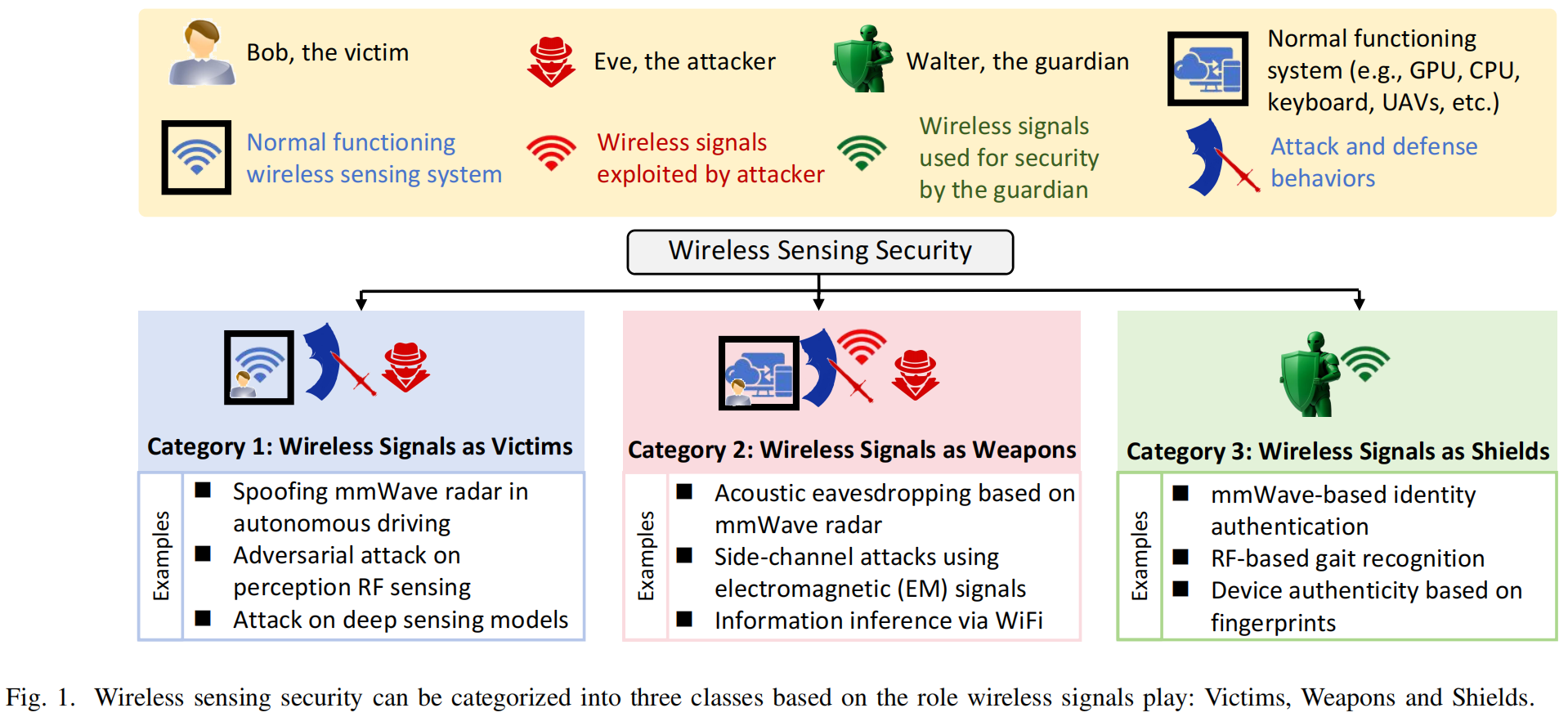
Diagram: wireless sensing security categorized into Victims, Weapons and Shields based on the role wireless signals play.
Fig. 1 — Three protagonists. Bob the victim, Eve the attacker, and Walter the guardian frame the role wireless signals play across the security landscape.
Taxonomy

The full map, expandable

The survey's structure as a navigable tree. Click any role to unfold its sub-areas and what each one studies.

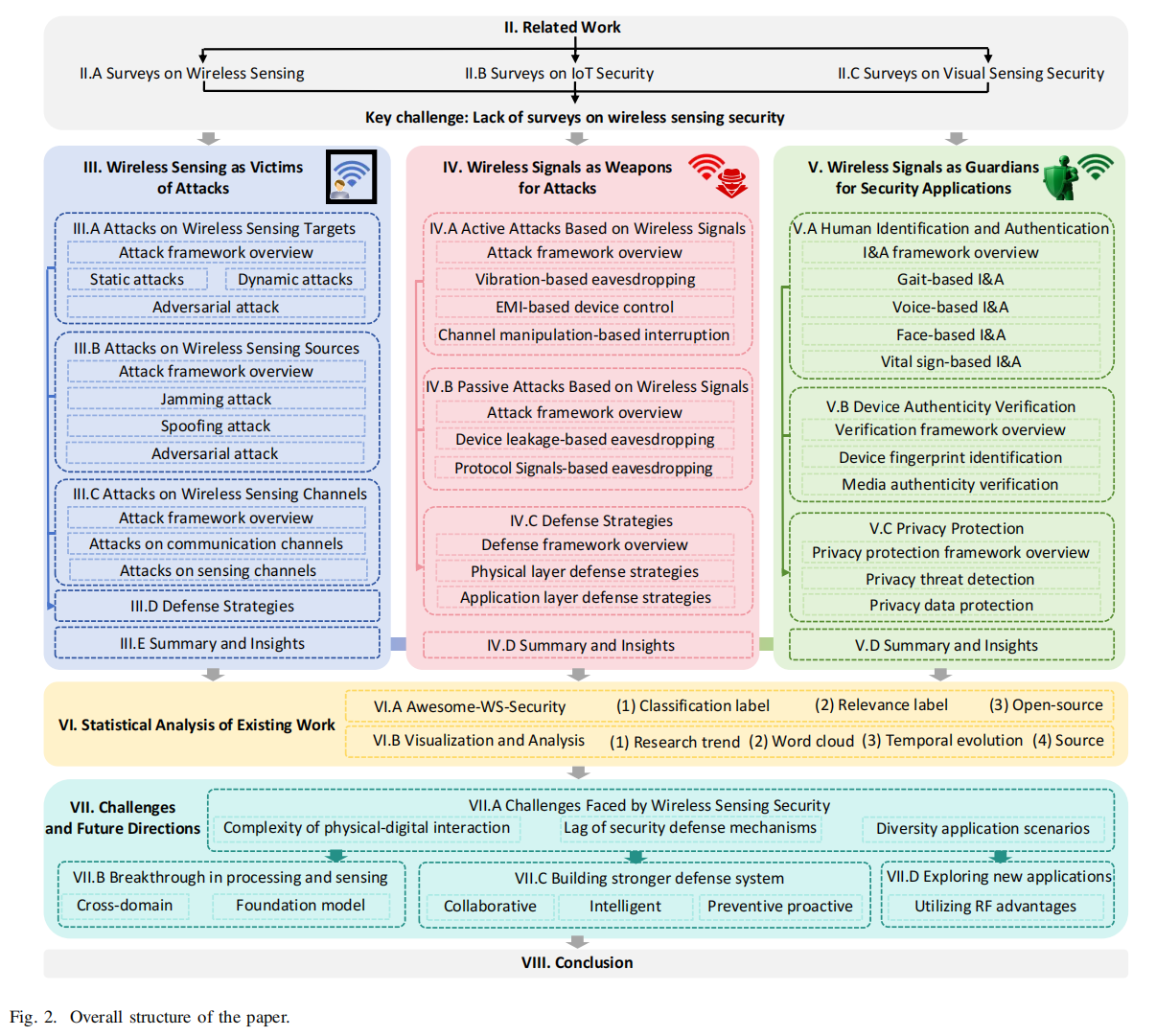
Overall structure of the survey paper, showing sections III–VIII and their subdivisions.
Fig. 2 — Overall structure of the paper, from the unified preliminary through the three roles to challenges and future directions.
The Complete Database

The full repository, searchable

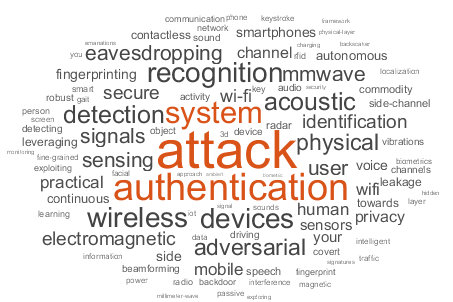
This is the entire Awesome-WS-Security table — the same list curated in the GitHub repository — embedded here with rich filtering. Search by keyword, narrow by role, venue, year range and relevance, and sort any column. Relevance score 1–4 marks how directly a work addresses wireless sensing security.

From 2004
To 2024
Year Venue Title Role Rel.
Challenges & Future Directions

Where the field must go next

Three fundamental challenges stem from the physical–digital nature of wireless sensing — and point to four directions for the next decade.

Challenge 1

Physical–digital complexity

Signal randomness, channel instability and interpretation difficulty make estimating x(t), hi, Θi, n(t) hard — attackers hide in this uncertainty; guardians must see through it.

Challenge 2

Lag of defense mechanisms

Defenders react while attackers innovate. The linear defense cycle is too slow against novel manipulations of the sensing model — even adaptive defenses get bypassed.

Challenge 3

Diverse, fast-moving scenarios

From autonomous driving to smart homes to 5G/6G and the metaverse — each imposes different requirements, demanding security be designed in from the start.

🔬

Breakthroughs in sensing algorithms

Cross-domain attack models and a unified multi-physics understanding — modeling how acoustic, mechanical and EM phenomena couple through Θi.

🧠

Foundation-model security

AI-driven intelligent attack & defense — robust representation learning, interpretability, channel prediction, and intelligent attack detection from y(t).

🛡

Stronger defense systems

Multi-level collaborative defense-in-depth, AI-adaptive strategies, and proactive measures that make attacks inherently difficult via channel shaping.

🫀

New applications: Cognitive Security

Non-contact, continuous sensing of physiological correlates of cognitive state — opening mental-health monitoring and trustworthiness assessment.

Citation

Cite this survey

If this work or the Awesome-WS-Security database is useful to your research, please cite:

@article{WirelessSensingSecurity2025,
  author  = {Geng, Ruixu and Wang, Jianyang and Yuan, Yuqin and Zhan, Fengquan
             and Zhang, Tianyu and Zhang, Rui and Huang, Pengcheng
             and Zhang, Dongheng and Chen, Jinbo and Hu, Yang and Chen, Yan},
  journal = {IEEE Communications Surveys & Tutorials},
  title   = {A Survey of Wireless Sensing Security From a Role-Based View},
  year    = {2025},
  doi     = {10.1109/COMST.2025.3597716}
}